
I Remember My Birth
To be true, must a story be true?

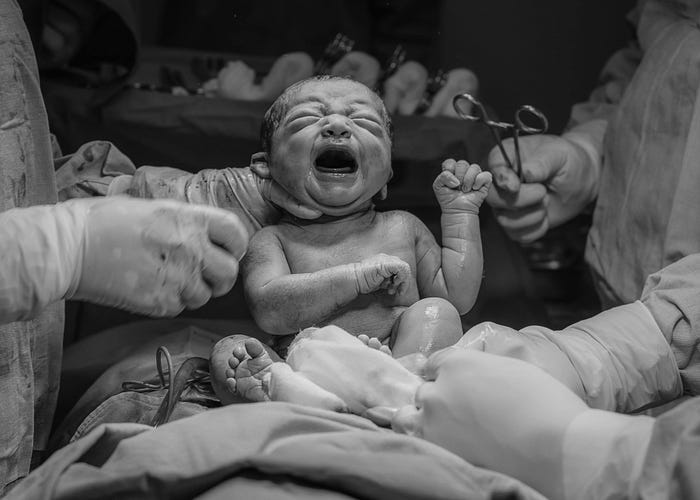
Panic yanked at Mother when she realized she was in labor. Forty years old and about to give birth for the first time, she arrived at the hospital distracted and wishing her mother were there with her. Her mother bore nine children. She would know what to do.
In the delivery room, the doctor ordered an injection that ushered Mother into a twilight, shifting everything into slow motion. The dulled pain of her contractions competed with the shame and discomfort she felt at having her feet in stirrups and the doctor positioned between her legs. She struggled to hear his instructions, which sounded as if they were spoken from somewhere far off, from a deep well or a tunnel.
“Push!” the doctor shouted.
She tried, but she felt so weary. She started to cry.
A nurse took her hand and said something to her she couldn’t quite understand. The words had a comforting lilt, like a lullaby.
“Push!” he shouted. “Push harder!”
She bore down, but her muscles tightened so slowly and she felt so weak that the effort seemed wasted. As the nurse squeezed her hand, Mother sensed the woman’s pity for her. She wondered if she was about to die. The nurse sang something softly in her ear.
“You are going to have to push harder,” the doctor yelled at her. His voice sounded like an alarm bell sounding in the distance.
The nurse leaned toward the doctor and shouted back at him, “She’s pushing as hard as she can!”
The doctor decided that forceps would be necessary. He used them to cup the baby’s head and pull Mother’s child — me — into the world.
She surrendered to sleep. She didn’t hear my first cry or ask if I was a boy or a girl. She didn’t feed me my first bottle. I was taken to the nursery where I was tended after my birth.
Exhausted, Mother slept through the night and awakened to hear a nurse asking her if she would like to see her daughter.
The story of my birth seems like a memory. It persists in my mind as if I had been there, a witness in the delivery room. I see the nurse hovering over my mother, trying to comfort her. I see the consternation on her face as the doctor stands between my mother’s legs, shouting at her. The steel forceps gleam, reflecting the delivery room lights as the doctor positions them to speed the delivery. My mother, deathly pale, lies unconscious on the delivery table after I am born.
My mother told me the story of my birth many times when I was growing up. After I was old enough to understand how babies are born, she recited it to me in almost the same words every time. It became a bedtime story, a tale told at birthday celebrations, an account shared when my grandmother came to visit. Giving birth to me, Mother said, was the most important event of her life — and one that almost killed her. When she narrated the events, her voice conveyed high drama in the delivery room, rising to a crescendo when the nurse shouted at the doctor.
Psychologists would call my seeming recollection of my birth a false memory — one that is implanted in the mind by someone else. We are told a story, perhaps repeatedly, and we develop a narrative in our minds that seems to be a memory. My birth memory is certainly false in the sense that I did not actually witness my own birth as an observer in the delivery room.
And the story itself may be false. My mother may have only imagined the scene in her drug-induced state. The events may not have happened exactly as she perceived them. If we were to ask the doctor what happened, for instance, he might tell a different story, as might the nurse.
The value of the memory is not in its factual accuracy. The memory is important because it is one part of the shared history that allows a group of people to cohere as a family. Like a myth or a folk tale, it encapsulates a set of images and impressions that help to solidify my family’s identity. A woman fearful of the birthing process who believes she is sacrificing her life to give life to another. A woman who defines her own life by the act bearing a child.
The memory of my birth is part of my family’s story. Does it have to be an actual memory, and does it have to be historically accurate, to be true? If I write a memoir of my childhood experiences, can I include this account as part of my story?
Surviving as a product of the collective consciousness that unites my family, the story of my birth may convey a truth more significant than facts. It reveals my mother’s perception of childbearing, for instance, and the relationship of a mother to her child.
I remember her reciting the story to me. But I also remember the events of the story itself, the same way I remember our Christmas tree falling on me when I was four, the neighbor’s dog biting me when I was five, or receiving my first bicycle for my sixth birthday. All of these stories play out in my mind as if I’m watching a home movie, as if my eyes were the camera’s eye.
I remember my birth. It may be a false memory. But for what it reveals about my life, it is a true story.
Dare to Tell is a reader-supported publication. To receive new posts and support my work, consider becoming a free or paid subscriber.